
CWA Calculator
Subject-wise Weighted Average Tool
| Course / Subject | Marks % | Credit Hours | Action |
|---|---|---|---|
0
CWA Calculator:
Today’s Student Population in Schools Requires Accurate Tracking of Their Academic Progress, which is why a Cumulative Weighted Average CWA Calculator can Help Keep Students up to Date. Whether in University, College, or a Professional Institution, it is Important to have an Accurate Account of Your Overall Cumulative Academic Achievement to meet your educational goals.
Calculating a student’s Cumulative Weighted Average (CWA) is an Evaluation System Used by Most Schools to measure a Student’s Overall Academic Performance. A CWA Calculates Your Total Weighted Course Average Rather than Just Averaging How Many Points You Earned for Each Course. Individual courses are given a Weight Based on the Number of Credits or the total importance of Each Course. Using a CWA Calculator Helps You Easily Determine your Overall GPA quickly, so you don’t have to Manually Calculate Your GPA, reducing the Chance of making a Manual Error.
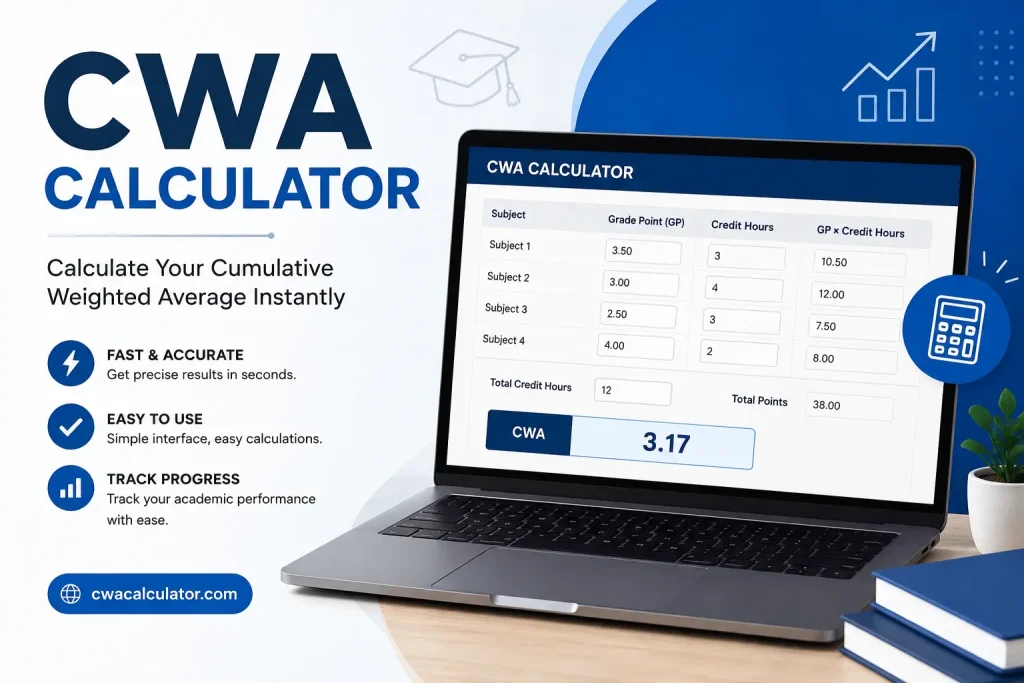
What Is a CWA Calculator?
A Cumulative Weighted Average (CWA) Calculator is a tool that calculates the overall average for a student over many classes or semesters. The big difference between the CWA calculator online and an ordinary average calculator is that the CWA calculator takes into account both the grade received for a class and the number of credits in that class when determining the final average.
Weighted averages are commonly used in the education system because certain classes hold more weight than others regarding academic performance. For instance, a four-credit class will have more impact on the final average than a two-credit class.
This tool allows students to calculate their cumulative weighted average based upon their grades and credit values quickly without having to go through a long manual calculation process.
Understanding Cumulative Weighted Average (CWA)
The Cumulative Weighted Average indicates a student’s complete academic performance during a specific term. This means that all grades from every finished class will be combined together to form one final grade, this grade (also known as your overall average) will take into consideration the level of difficulty of each topic area as determined by the institution.
The Cumulative Weighted Average allows a student’s higher-weighted course to affect his/her final average more than any lower-weighted course, the grading system is therefore more representative of a student’s overall performance than simple average calculating.
Many tertiary institutions have a Cumulative Weighted Average requirement for the following reasons:
- Determine Academic Standing
- Determine Scholarship eligibility
- Determine Graduation Requirements
- Determine qualifications for Dean’s List
- Determine qualifications for postgraduate admissions
When a student understands how these calculations work, the student can make more informed subacademic decisions.
How Does a CWA Calculator Work?
This method of calculating your GPA is a simple calculation; take each of your class grades, times the credits that particular class is worth, then add all those numbers together and divide that number by the total credits.
The general formula is:
CWA=\frac{\sum(Grade\times Credit\ Hours)}{\sum Credit\ Hours}
Higher weighted average course grades positively correlate with achieving a higher average. That is, if a student has achieved higher grades in more courses that are wighted more heavily (i.e., one major’s credits) than in lesser courses, then the total weighted average will also be greater, showing the student’s accomplishment more significantly.
Why Students Use a CWA Calculator
Academic CWA Calculator tool allows students to accomplish a variety of things. They can provide immediate feedback (i.e., immediate or near-instantaneous answers) that saves time compared to doing calculations by hand. Students can also track progress throughout the term.
Academic planners are another example of using academic tools to determine the future grades that a student will need in order to have a specific cumulative average. In addition to helping students with academic planning, academic tools can also help prepare for scholarships, internships and graduate programs where academic performance is an important factor in being selected.
Benefits of Using a CWA Calculator
Error-Free Results
Doing things the old-fashioned way will usually end in errors, which is compounded when there are many different classes and credits involved in the process. By automating the calculation process, many of these potential errors can be eliminated.
Quick Results
Students no longer need to spend hours performing complex calculations; they can now receive the results in seconds.
Planning for the Future with CWA Calculator
With this tool, students can see what outcomes may occur, allowing them to develop plans to better their performance for future semesters.
Tracking Goals
Users can now compare their current situation is with where they want to be academically so that they can make the necessary corrections.
Better Decisions
By being able to see how they have performed cumulatively, students can make better decisions on courses taken, how they manage their time and the importance of various subjects.
Difference Between GPA and CWA
Lots of students get GPA and CWA mixed up because they both show how well you are doing in school.. There are some big differences between GPA and CWA.
Grade Point Average (GPA)
GPA is usually figured out by using points that go with the grades you get. For example the school gives you a number of points for an A or a B. GPA often goes up, to 4.0 or 5.0 it just depends on the school you are going to.
Cumulative Weighted Average (CWA)
CWA looks at grades and course weights. It shows how well you do in each subject.
On the hand GPA turns grades into the same points for everyone. CWA uses the percentages or scores you get and also considers how many credits the course is worth.
Both CWA and GPA are useful. Some schools like one better, than the other.
Step-by-Step Guide to Calculating CWA Online Calculator
The calculation of a cumulative weighted average can be completed manually using the following six steps:
1: Gather final course grades for all completed courses
Step 2: Assign a credit value to each of the course grades
Step 3: For each course, multiply the final grade by the number of credit hours that have been assigned to it
For example:
1Course A = Grade 80 x Credit 3 = 240
Course B = Grade 90 x Credit 4 = 360
Course C = Grade 75 x Credit 2 = 150
Step 4: Add all of the weighted scores for each of the courses
240 + 360 + 150 = 750
Step 5: Add the total number of credits (credit hours) for all of the courses
3 + 4 + 2 = 9
Step 6: Divide the total weighted score by the total credits
750 ÷ 9 = 83.33
Therefore, the student’s cumulative weighted average will be 83.33.
Common Applications of CWA Calculations
Scholarship Evaluations
- Many committees that give out scholarships want students to have grades.
- These scholarship committees need students to keep up their work.
- They want students to have a level of academic achievement.
Academic Honors
- Universities use weighted averages to decide who can be in honors programs.
- They also use weighted averages to give out awards.
- These universities want to recognize students who do a job.
Graduation Requirements
- Some universities require students to have a cumulative weighted average.
- This cumulative weighted average is needed to graduate.
- Students have to achieve this cumulative weighted average before they can graduate.
Internship Opportunities
- When employers look at people who want to work for them they consider performance.
- Employers think about how students did, in school.
- They want to know about the students performance during their evaluations.
Repeated Courses
- Some schools replace the grade when a student repeats a course.
- Other schools include all the grades when a student repeats a course.
- This can affect the students weighted average.
Future of Academic Performance Tracking
- Technology is changing the way we learn. New systems for managing schools are using analytics and automated tracking to follow student performance.
- In the future we may see tools that use math to predict how well students will do based on how they are doing now. This will help students make choices about their education and do better in the long run.
- As schools keep using tools, CWA fee calculators that help students figure out their average grades will still be very helpful to students all around the world. Technology is really helping to improve education and schools are using technology to make things better, for students.
- Technology and education are closely. Technology is making education better. Schools are using technology to help students and technology is helping students to do better in school.
Conclusion (CWA Calculator)
A cumulative weighted average CWA calculator is an important tool for school that helps students figure out their cumulative weighted average. It looks at the grades they get and the credits for each class so it gives an idea of how they are doing in school than just a simple average.
Whether you are checking on how you’re doing planning what classes to take next trying to get a scholarship or getting ready to graduate knowing about cumulative weighted averages can really help you with school. Using a cwa calculator to do the math saves you time makes sure you get the right answer and helps you make good choices, about school.